Po-Han Huang

AI Research Engineer • Computer Vision • Deep Learning

I build practical vision systems and study data-efficient learning for real-world inspection. Current interests include training-free / few-shot anomaly detection, segmentation, and robust deepfake detection.

Industrial Anomaly Detection Foundation Models Segmentation Robustness

Email: alan880603@gmail.com

Quick Summary

  • AI Research Engineer @ Inventec — smart-manufacturing work
  • WACV 2026: PatchEAD (industrial anomaly detection)
  • ICASSP 2024: limited supervised foot ulcer segmentation
  • MM Asia 2023 / Neural Networks 2023: deepfake & anti-spoofing

Tech: Python, C/C++, Docker, FastAPI, ONNX/TensorRT, Triton, Gradio

Research

Research Interests

My research focuses on bridging strong foundation models with reliable real-world deployment. I’m particularly interested in:

  • Industrial anomaly detection: training-free / few-shot, patch-level explainability, robust evaluation.
  • Segmentation under limited supervision: cross-domain augmentation, ensembling, practical pipelines.
  • Robust deepfake detection: cross-dataset generalization and difficulty-aware learning.
  • Data synthesis: diffusion-based defect synthesis & augmentation to reduce collection cost.

Keywords

Anomaly Detection Patch-level Methods Vision Prompting Segmentation Synthetic Data Generalization Open-set Deployment

Experience

AI Research Engineer — Inventec Corporation
May. 2024 – Present • Taiwan
  • Designed and deployed an explainable defect inspection pipeline for manufacturing.
  • Worked on robustness and verification-friendly anomaly localization for production use.
  • Developed diffusion-based defect synthesis to reduce data collection burden.
  • Published a training-free / few-shot anomaly detection paper accepted at WACV 2026.
AI Research Engineer Intern — Inventec Corporation
Apr. 2023 – Oct. 2023 • Taiwan
  • Built an end-to-end wound size measurement pipeline (marker → scale → segmentation).
  • Improved segmentation quality through practical training/optimization and ensembling.
  • Published the study at ICASSP 2024.
Research Assistant — Academia Sinica
Jan. 2022 – Aug. 2023 • Taipei, Taiwan
  • Studied generalized deepfake detection for cross-dataset robustness.
  • Explored difficulty-aware learning and multi-head prediction with soft labels.
  • Published the work at MM Asia 2023.

Publication

Po-Han Huang, Jeng-Lin Li, Po-Hsuan Huang, Ming-Ching Chang, Wei-Chao Chen — WACV 2026
Shang-Jui Kuo*, Po-Han Huang*, Chia-Ching Lin, Jeng-Lin Li, Ming-Ching Chang — ICASSP 2024
Po-Han Huang*, Yue-Hua Han*, Ernie Chu, Jun-Cheng Chen, Kai-Lung Hua — MM Asia 2023
J.-D. Lin, Y.-H. Han, P.-H. Huang, J. A. Tan, J.-C. Chen, M. Tanveer, K.-L. Hua — Neural Networks 2023

Full publication list: Google Scholar

Project

STAS thumbnail

STAS (Medical Image Segmentation Challenge)

Repository for our award-winning solution in a medical image segmentation competition, including training, inference, and experiment configurations for reproducible results.

Research Artifacts (Pipelines)

Below are simplified pipeline overviews for selected papers. Each figure highlights the main idea and the system-level flow.
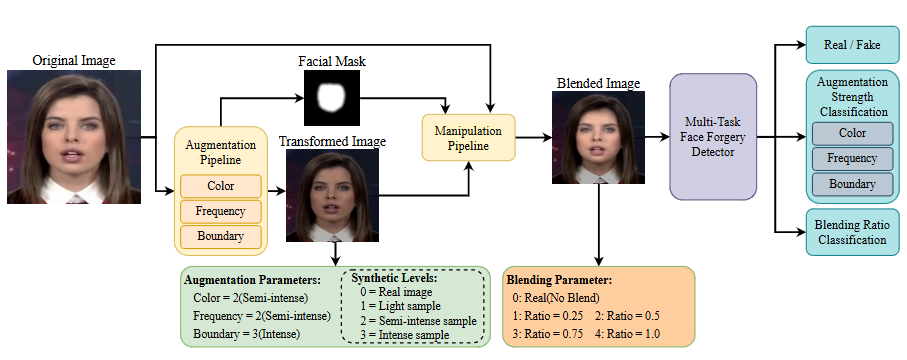
MM Asia 2023 pipeline
MM Asia 2023 • Deepfake Detection
Multi-Task Self-Blended Images for Face Forgery Detection

A robustness-oriented deepfake detector that learns with multi-task supervision. The pipeline encourages the model to capture forgery-consistent artifacts by jointly optimizing complementary objectives (e.g., forgery cues and auxiliary predictions), improving generalization across manipulation types and datasets.
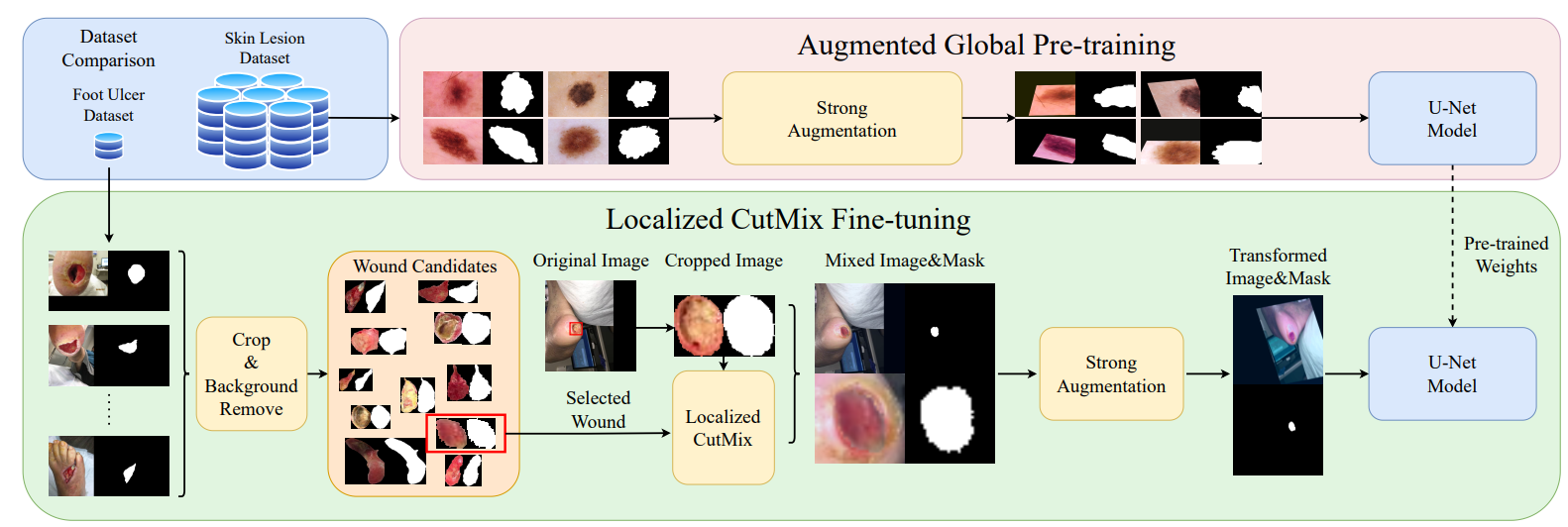
ICASSP 2024 pipeline
ICASSP 2024 • Medical Segmentation
Limited-Supervised Foot Ulcer Segmentation via Cross-Domain Augmentation

A practical segmentation framework for limited labels: cross-domain augmentation expands appearance diversity, while model ensembling stabilizes predictions. The pipeline is designed for real-world clinical variability and improves robustness under limited supervision.
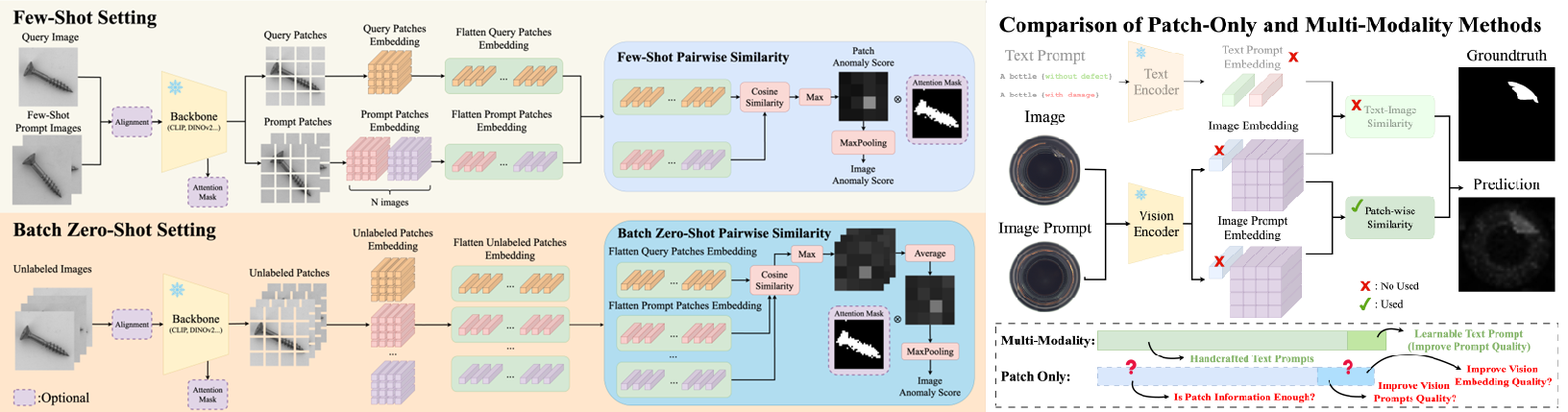
WACV 2026 pipeline
WACV 2026 • Industrial Anomaly Detection
PatchEAD: Patch-Exclusive Anomaly Detection with Industrial Visual Prompting

A training-free / few-shot industrial anomaly detection pipeline that produces patch-level anomaly maps for verification. The core idea is to unify visual prompting signals and patch-level comparisons to localize anomalies, enabling reliable inspection with minimal data and strong interpretability.

Contact

This will open your default email client.

Direct email: alan880603@gmail.com